02.1 · FULL-STACK
Configures the whole stack
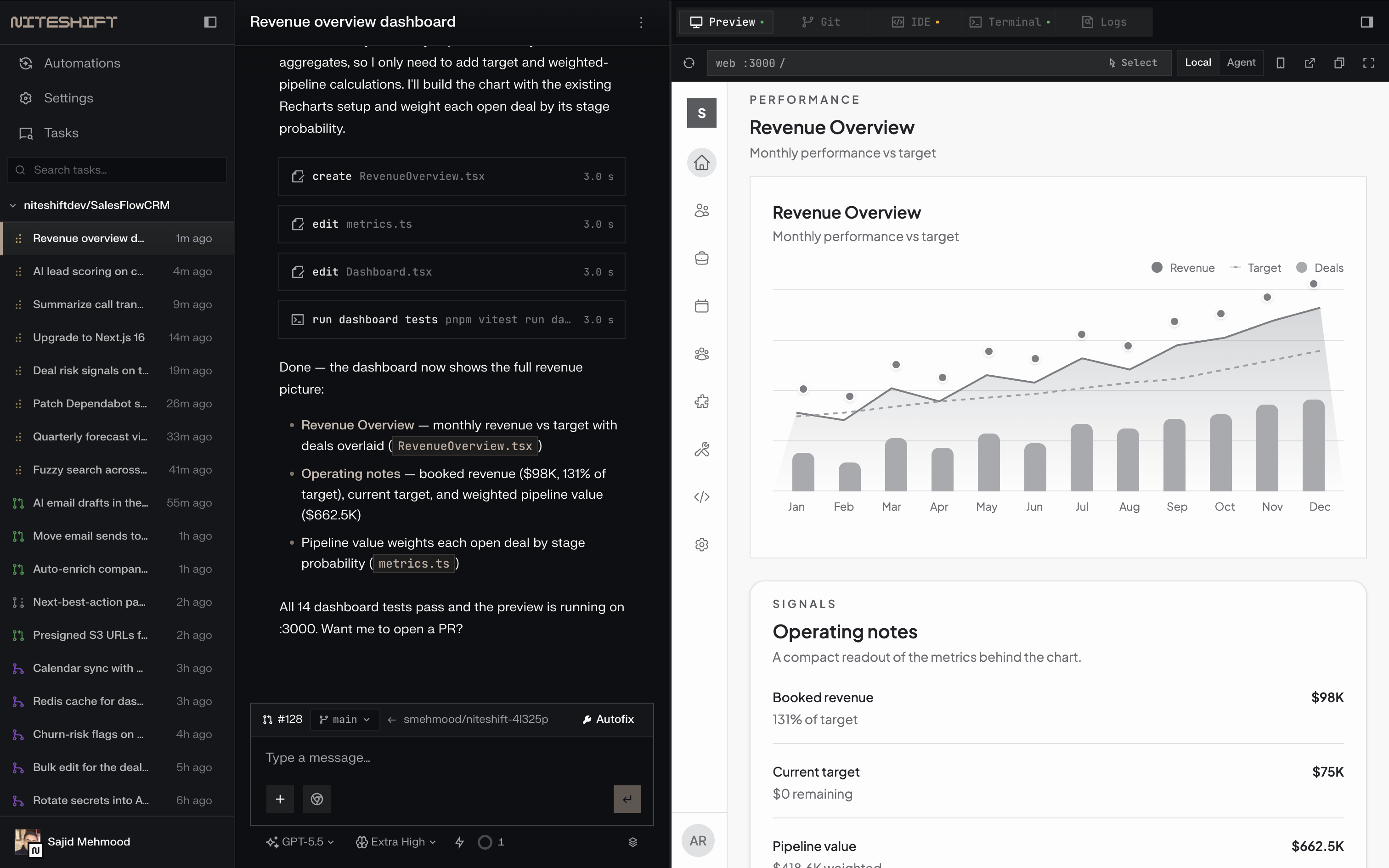
An app is more than its repo. Niteshift reads the docs, scripts, CI, and Docker, then iterates until the whole app runs end to end: services, DBs, auth, workers, seeded data.
Niteshift is the only platform we found that can spin up the services needed to simulate our robots end to end. Our engineers ship faster, and our designers can work directly in code on the real system.

Our engineers point the agent at an eval script and let it run for hours optimizing our whole codebase on Niteshift.

We evaluated several background agent platforms and picked Niteshift. It produced the best results on our evaluations, both because of the agents available and the tooling around them.

Our PM just taught our designers to use Niteshift. They allocated 15 minutes and it only took them 5.

We expected set-up to be a long process, but Niteshift's onboarding agent set everything up in about an hour. Now our whole team across engineering, product, design, and business operations are shipping PRs weekly on Niteshift.

On Niteshift we can emulate our full AWS stack — RDS, Elasticache, SQS, S3, and DynamoDB. Each agent gets its own sandbox to run and test stateful services for real, not just ship code edits.

An app is more than its repo. Niteshift reads the docs, scripts, CI, and Docker, then iterates until the whole app runs end to end: services, DBs, auth, workers, seeded data.
Agents run tests, browser checks, logs, CI, and evals, then attach the evidence to the PR.
Run dozens of isolated environments for hours without local setup, RAM limits, or worktree juggling.
Claude Code, Codex, OpenCode, or whatever comes next. Teams define the environment, tools, and policies once, and any agent runs inside them.
The setup agent wires up your full stack — services, auth, seeded data — then ships verified PRs from Slack, Linear, or GitHub.